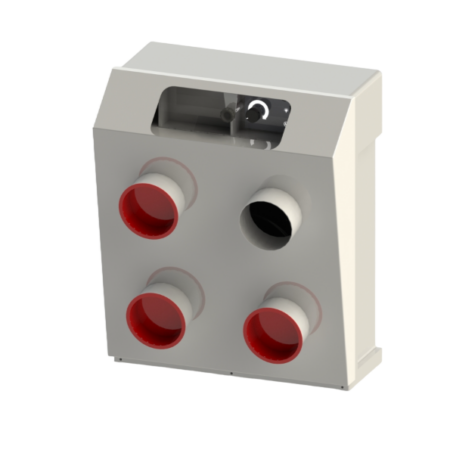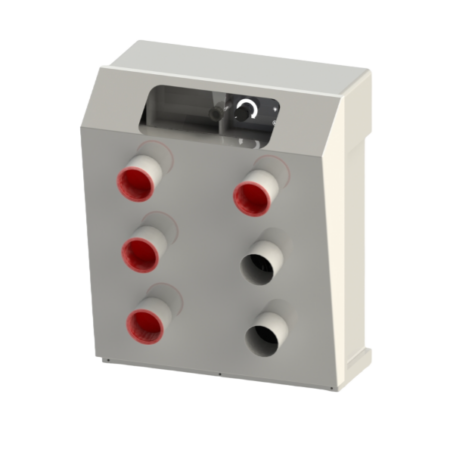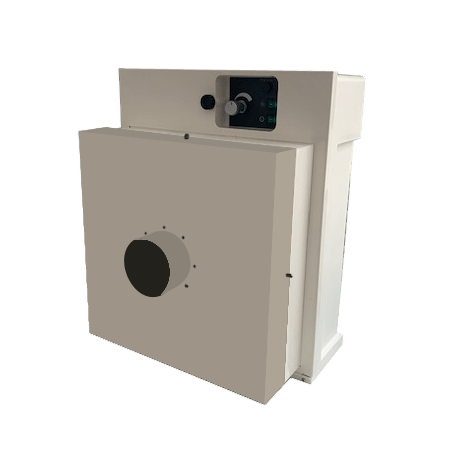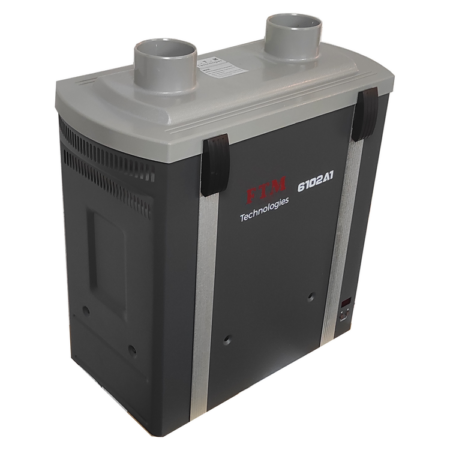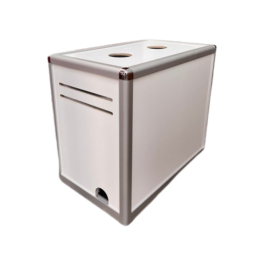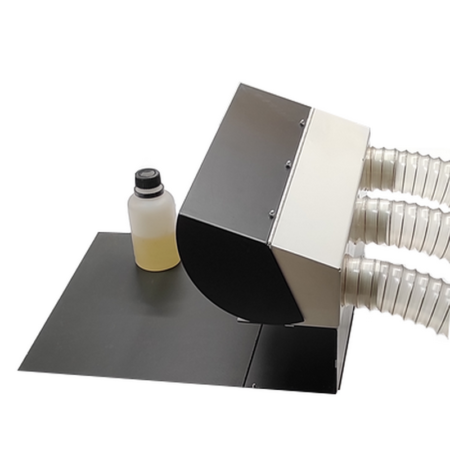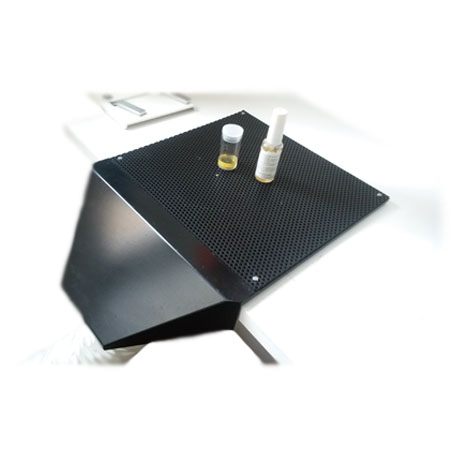
Our multi-operator hoods connect one or more workstations simultaneously
Ideal for tin welding workshops or solvent applications. A HEPA version is also available for the filtration of fine particles.
A wide choice of suction arms of different types and diameters and captation accessories can be connected to the suction box.
FAQ – Local Extraction Hoods & Air Filtration
What is a local extraction hood?
A local extraction hood captures fumes, vapours, solvents, dust and fine particles directly at the source to prevent their dispersion into the workshop or laboratory air.
What types of hoods are available?
The range includes:
- Single-station hoods,
- Multi-station hoods (4 or 6 inlets),
- Mobile hoods,
- High-efficiency HEPA models for very fine particles.
Some models operate in recirculating mode only, while others can be connected to an external exhaust system.
Which filters are compatible?
Depending on the model, the hood can be equipped with:
- a pre-filter for dust and coarse particles,
- a HEPA H13 / H14 filter for fine and submicronic particles,
- a activated carbon filter for solvents, VOCs and odours.
Filters may be combined depending on the application.
Which extraction arms can be used?
Two families of extraction arms are compatible:
- Segmented (flexible) arms,
- Articulated laboratory-type arms.
For available versions, please refer to the “Segmented arms” and “ME articulated arms” product categories.
How many arms can be used simultaneously?
Even if some hoods have 4 or 6 inlets, it is recommended not to use more than two arms at the same time.
Above this limit, airflow foisonnement significantly reduces the capture efficiency on each arm.
Above this limit, airflow foisonnement significantly reduces the capture efficiency on each arm.
Which pollutants can be captured?
Depending on the installed filters, the hood can capture:
- soldering and desoldering fumes,
- light solvents (alcohol, acetone, etc.),
- flux vapours and VOCs,
- fine dust,
- submicronic particles with HEPA H14,
- small plastic or metal particles.
Segmented arms are not recommended for corrosive vapours or strong acids.
Can the hood operate in recirculating mode?
Yes. Most models are designed for closed-loop recirculation with HEPA and/or activated carbon filtration.
Some models, such as the HI-HEPA, operate exclusively in recirculating mode and cannot be connected to an external exhaust.
Some models, such as the HI-HEPA, operate exclusively in recirculating mode and cannot be connected to an external exhaust.
Can the hood be connected to an external exhaust?
Yes, provided the model is designed for this purpose.
Multi-station hoods include an outlet for connection to an extraction duct.
This is not possible for hoods intended for recirculating-only operation, such as the HI-HEPA.
Multi-station hoods include an outlet for connection to an extraction duct.
This is not possible for hoods intended for recirculating-only operation, such as the HI-HEPA.
What is the recommended capture distance?
For optimal performance, the capture nozzle should be positioned as close as possible to the emission point, typically at a distance of 2–3 nozzle diameters.
The closer the arm, the higher the capture velocity.
The closer the arm, the higher the capture velocity.
What maintenance is required?
Basic maintenance includes:
- periodic replacement of filters (pre-filter, HEPA, carbon),
- cleaning of the extraction arms and nozzles,
- regular verification of airflow and depression,
- checking the sealing and tightness of all connections.
Do HEPA hoods filter very fine particles?
Yes. H14-class filters capture up to 99.995% of particles ≥ 0.1 μm, covering most fine dusts and submicronic particles encountered in workshops and laboratories.
Can multi-station hoods be fitted with a pre-filter?
Yes. A pre-filter can be installed upstream of the HEPA and carbon filters.
It is recommended to retain coarse dust and extend the lifespan of the main filters.
It is recommended to retain coarse dust and extend the lifespan of the main filters.
💡 Tip: For consistent capture performance, limit simultaneous use to two arms, keep the nozzle close to the source, and monitor filter condition regularly.
- Display 36 Products per page