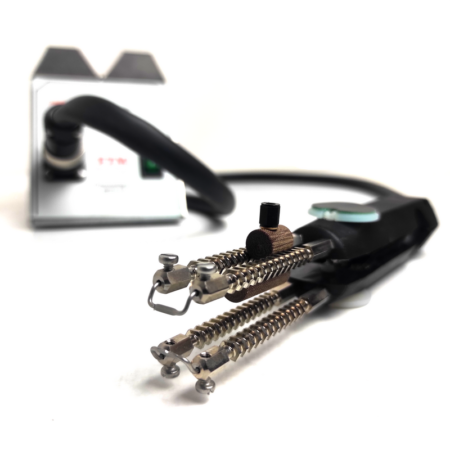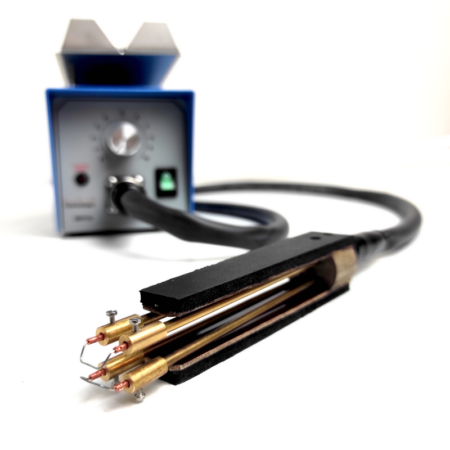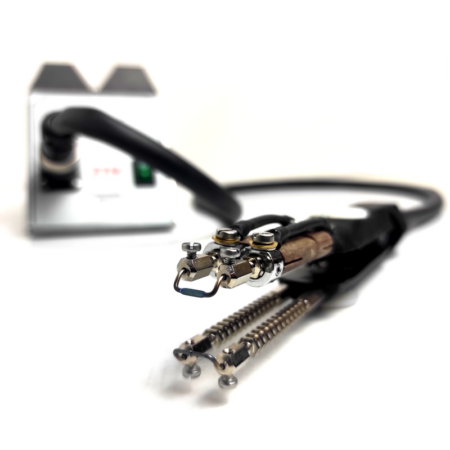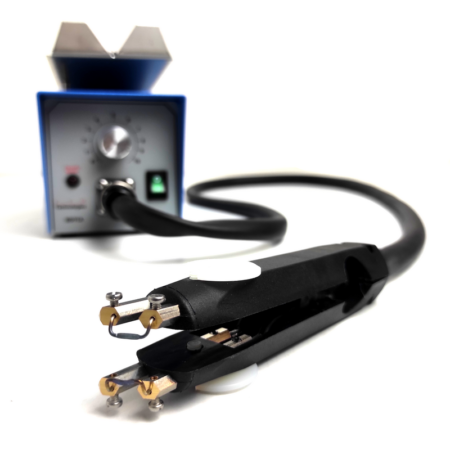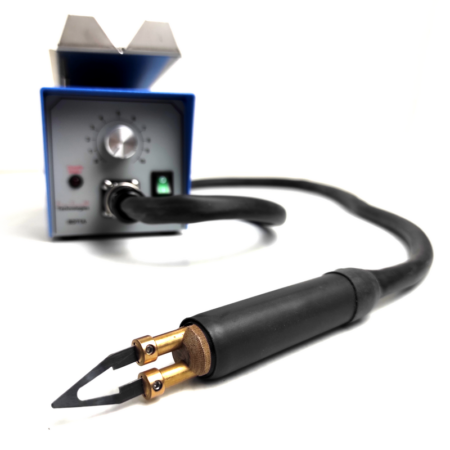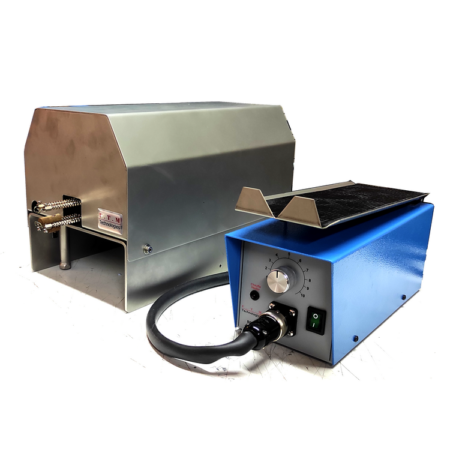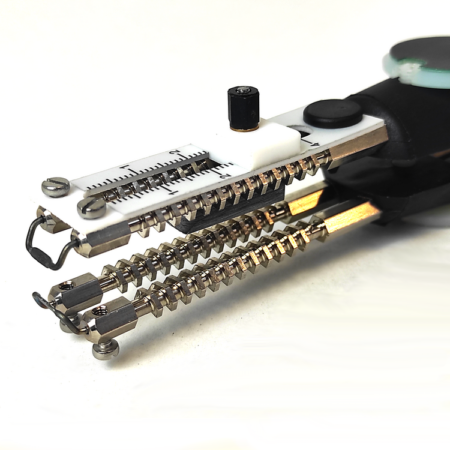
Stripping of PVC, Nylon, Kynar®, Tefzel®, silicone, Teflon, Kapton® …
FTM Technologies offers a range of:
• 3 power supply models : A circuit breaker or contact trigger
• 5 ergonomic pliers provide a comfortable grip covering a range of AWG 4 to 36 gauges
• Numerous easily interchangeable electrode models for different applications
Save time! Choose the right equipment for your needs by consulting our concordance table between our proposed gauges and strippers.
If in doubt, give us your cable samples and we will help you qualify the right tool.
FAQ – Thermal Wire Stripping – FTM Technologies
Why choose thermal wire stripping?
Thermal stripping removes the most resistant insulations (Teflon®, Kapton®, Kynar®, Tefzel®…) without damaging the conductor. Unlike mechanical stripping, it avoids marks on the copper, broken strands or insulation tearing, while eliminating the injury risks linked to scalpels or blades.
Which models are available?
- BDT1A – Bench unit, heating triggered when the pliers are picked up.
- BDT3A – Contact-activated stripper, heating starts when the pliers are closed.
- BDT3TS – Thermostripper with OLED display, heating adjustable from 0 to 100%, ESD compatible.
- CCT / Thermotranchet – Thermal knives for jacket stripping or window stripping on large cables.
What types of wires or cables can be stripped?
All high-performance insulations can be processed, including:
- PTFE, Teflon®, Tefzel®, Kapton®, Kynar®, Silicone, Nylon, PVC…
- Round or flat wires of all sizes (AWG 36 to AWG 4 depending on the electrodes).
- Twisted wires, coaxial cables, ribbon cables, enamelled wires (with suitable electrodes).
How does a thermal stripper work?
The electrodes heat instantly when they touch the wire and soften the insulation without tearing it. The strip length is set using an adjustable stop, and heating stops automatically when the pliers are released. On BDT3TS models, the temperature is adjusted via the OLED display.
What temperature can be reached?
Depending on the model and electrode type, the temperature ranges from 70 °C to over 850 °C.
BDT3TS units allow fine adjustment from 0 to 100% to match different insulations (PE, PTFE, Kapton…).
What are the main differences between BDT1A, BDT3A and BDT3TS?
- BDT1A: heating triggered when picking up the pliers, simple and robust.
- BDT3A: heating triggered by plier closure, keeping the working area free.
- BDT3TS: digital adjustment, ESD compatible, universal supply (110–230 V).
Which pliers and electrodes are available?
- Pliers PC3N / PC3NC / PC4N / PC3NP / PC3/5 depending on wire type and task (twisted, large cable, ESD, etc.).
- Electrodes EEDT2, EDT2P, EEDT4, ELECT-A/B/C for wire gauges AWG 8 to 36.
- Accessories: adjustment ruler KIT.REG and SLUG REMOVER for safe insulation removal.
Is an antistatic (ESD) version available?
Yes. BDT3TS and BDT3A can be used with PC3NC-ESD pliers specially insulated for sensitive environments.
What are the advantages compared with mechanical stripping?
- No marks or broken strands.
- Clean, repeatable stripping even with high-temperature insulations.
- Time saving and safer handling (no blades or cutting tools).
How should the stripper be maintained?
Regular brushing of the electrodes with the supplied wire brush is sufficient.
Screws should be tightened periodically according to the torque indications for the selected pliers.
Electrodes must be replaced when oxidised or if conductivity decreases.
Can large cables be stripped?
Yes, with CCT and Thermotranchet tools powered by BDT1A or GG2 units.
They allow longitudinal stripping and window cutting on large-diameter cables, even with highly resistant insulation such as Kapton®.
- Display 36 Products per page