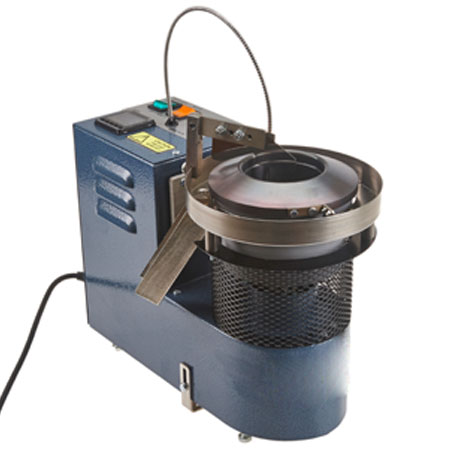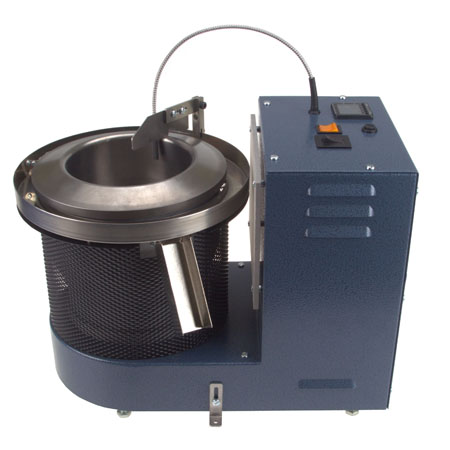
Tinning is the application of a thin layer of tin alloy on a metal part, we can make through these means the operations of De-enamelling and degolding.
Our rotating tin baths make it possible to keep a clean and bright tin surface constantly thanks to the rotation of the crucible and the scraping performed by the fixed blade which recovers the slags and evacuates them.
We offer several models of rotary pots that differ in size, service temperature and the possibility of having a variator motor
FAQ – Rotary Solder Bath
What is a rotary solder bath used for?
The rotary solder bath is used to tin and clean wire ends continuously, especially when several wires or litz wires must be treated in sequence.
The rotation keeps the molten solder surface clean and ensures a constant, homogeneous solder layer on all parts.
What is the advantage of the rotating pot compared to a static bath?
The rotating pot offers three key advantages:
- Clean surface at all times thanks to the permanent skimming system.
- Uniform temperature around the circumference.
- Faster cycle when several conductors have to be tinned one after another.
This makes it particularly suitable for production or repetitive harness work.
Can it be used for enamelled copper wires or litz wires?
Yes. This is one of the strong points of the FTM rotary bath: the HT (high temperature) versions can reach a temperature high enough to crack and remove the enamel on enamelled copper wires or litz wires.
And because the bath is constantly skimmed, the residues of enamel, varnish or polyimide that detach from the wire are removed from the solder surface and do not contaminate subsequent parts.
What temperatures can be reached?
Standard versions are suitable for tinning at classic temperatures.
HT versions are designed for very high temperatures specifically for enamel removal and demanding tinning operations.
How does the permanent skimming work?
The rotating device drags the impurities (flux remains, enamel flakes, varnish, polyimide residues) to a skimming zone where they are removed.
This keeps the solder surface clean and wettable, which is essential for repeatability.
What kind of parts can be processed?
The rotary solder bath can process:
- Single wires and multi-strand wires.
- Litz wires and enamelled copper wires.
- Small copper parts that need to be tinned before soldering.
- Wire ends to be prepared for crimping or connector soldering.
Is flux always required?
Not always. Since the bath surface is kept clean, a lot of operations can be done with minimal or no flux.
For enamelled wires or oxidised parts, using a suitable flux will improve wetting and reduce the immersion time.
Can it be integrated into a production line?
Yes. The rotary bath can be used as a standalone workstation or as a module in a tinning or cabling line, especially when several identical wires must be treated successively.
What are the main advantages of the FTM rotary bath?
- Perfectly clean solder surface thanks to permanent skimming.
- Suitable for high-temperature (HT) operations.
- Recommended for enamel cracking of enamelled or litz wires.
- Repeatable tinning quality for wiring and harness shops.
- Easy to maintain and to refill with solder bars.
- Display 36 Products per page